


Most losing trades are not “bad ideas.” They are poor entries.
A wide stop, a missed target, and a blown account often start the same way: you entered where liquidity was thin, late, or already taken.
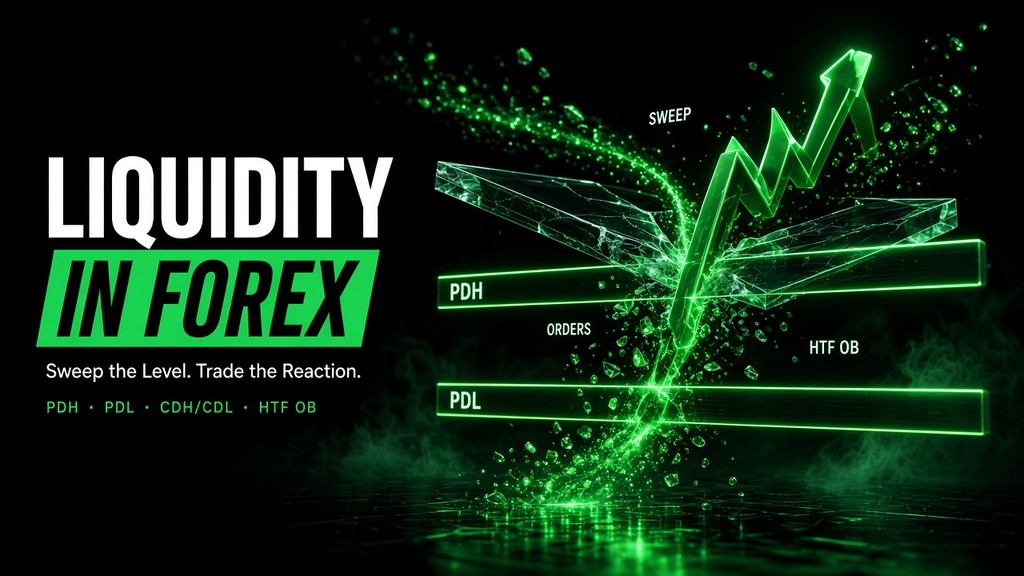
Liquidity sounds fancy. In practice it is simple: orders. Buy orders and sell orders stacked above and below important levels. When price hits those levels, the market can accelerate, reverse, or trap you — depending on whether you waited for the sweep or bought the first touch.
This guide is how a working forex/gold trader finds high-probability liquidity, takes cleaner entries, and stops mixing ten concepts into one confused click.
The only strategy you need before liquidity jargon
Trading still boils down to two steps:
- Mark an important level
- Wait for price action at that level
Example: resistance is clear → price arrives → selling pressure shows → you sell.
That is the base. Liquidity does not replace it. Liquidity tells you which levels matter most and when to act.
If your entry is poor:
- Stop is wide
- Target rarely hits
- Losses stack even when direction was “kind of right”
Improve the level → improve the entry → improve everything after.
What liquidity actually means on a chart
Skip heat maps and expensive tools for a moment.
Liquidity = concentrated buy/sell orders around a level.
Why did price fall from a high three times? Because selling pressure showed up there — sell-side orders. Why did a low hold? Buy-side orders defended it.
So:
- Above important highs → often sell-side liquidity (stops of longs + fresh sellers)
- Below important lows → often buy-side liquidity (stops of shorts + fresh buyers)
Liquidity exists everywhere. Without it, price barely moves. Your job is not “find liquidity.” Your job is find high-probability liquidity — places where bigger players repeatedly care.
The trap: marking 100 levels
On a daily chart you can draw demand from a wick, extend it, catch another wick, then a body — suddenly you have five “important” levels. Drop to 15-minute gold and you can mark highs, closes, supports all day.
That is how overtrading starts.
Reading and execution are different skills. In live markets, too many tools = paralysis or revenge mixing: trap trader one minute, retest trader the next.
Rule: leave something on the table. You will not catch every move. Trying to catch everything is how you overtrade.
Focus on a short high-probability list.
Best liquidity levels (priority order)
1) Previous day high & previous day low (strongest for many traders)
For 24-hour markets like gold, previous day open/close matter less than in exchange-session markets (indices). Prioritize:
- Previous day high (PDH) — use the wick extreme
- Previous day low (PDL) — use the wick extreme
Why these are liquidity magnets
A prior-day high is where price failed to go further. Above it, someone large often gets uncomfortable — dealers/institutions managing hedges, options, futures, cash exposure. You do not need to know which order they used. You need to know the level invited sell-side liquidity.
Same logic inverted at prior-day lows: buy-side defense / liquidity below.
How to trade them
- Do not buy/sell the first touch blindly (lower quality; stop gets wicked then price leaves)
- Prefer a liquidity sweep: wick beyond PDH/PDL, then rejection / displacement back
- After a sweep, look for continuation structure (e.g. FVG fill then breakdown/breakout) on 5m/15m for precision
Real-chart pattern you will see often:
- Price sweeps PDH → traps breakout buyers → dumps
- Price sweeps PDL → traps breakdown sellers → rallies
- Sometimes the level “proves” itself only after a second visit once dealers have shown they care
You will not get 100% wins. You get location with meaning.
2) Current day high & current day low (useful — but timing is everything)
CDH/CDL become meaningful only after the day has built a real range.
Common sense rule
If gold’s average daily move (ATR on the daily timeframe) is ~$80–$100, do not treat a tiny $20–$30 morning range as “the” high/low to fade or hunt for a crash.
Practical filter many traders use:
- Take daily ATR
- Subtract ~20–30%
- Only treat CDH/CDL sweeps as high quality once the day’s range has expanded toward that threshold
Example mindset: ATR ≈ 80 → wait until range is roughly in the 50–70 area before CDH/CDL liquidity trades matter. Exact numbers change with volatility — use judgment, not a religion.
Also required: confirmation
Reading liquidity is not enough. You need price action:
- Sweep of CDL + close back above / bullish confirmation on your TF
- Not a weak probe that never closes through your level
Stay one identity
If you are a sweep/trap trader, do not flip into “retest trader” mid-setup because fear whispered.
If you are a retest trader, take retests — do not suddenly chase sweeps.
Live markets destroy people who switch playbooks every candle.
Stops
Do not glue the stop one tick beyond the wick. Give room past round numbers / noise ($2–$3 on gold-style moves when structure demands it). Tight vanity stops get hunted; logical stops survive.
3) Higher-timeframe order blocks (HTF OB)
If you execute on 5-minute, read order blocks on 15-minute.
If you execute on 15-minute, read on 1-hour.
Do not build your bias from 5-minute order blocks as primary (low probability noise). You can scalpel entries on 5m — but the zone should come from HTF.
How to use
- Mark the most obvious swing top / swing bottom order blocks on HTF
- Prefer OBs that also left imbalance (FVG)
- Prefer OBs that already interacted with a sweep
Wide stop problem
HTF OB stops can be large. Two options:
- Cut size with a risk calculator so dollar risk stays fixed and RR still works
- Refine: drop to 5m, wait for an FVG retest inside the HTF story, place a tighter stop beyond that micro structure
Expect refinement to work often — not always. Sometimes price drops straight through with no polite pullback. Those misses are why you do not force every HTF OB.
4) Other liquidity (know them — do not stack them all)
Also real, but secondary for many intraday traders:
- Session high/low (London/Asia sweeps) — often poor hit rate if used alone
- Swing high/low, double top/bottom, classic S/R
- Value area high/low (volume profile) — strong for some systems; treat as its own class
- Swing POC — useful mainly for swing work; easy to overfit intraday
Internal vs external (simple map)
External liquidity people hunt: day H/L, session H/L, swing H/L, double tops/bottoms, S/R.
Internal liquidity people refine with: order blocks and FVGs.
You do not need fourteen tools open at once.
Entry checklist (liquidity edition)
- Is this PDH/PDL, a mature CDH/CDL, or an HTF order block — not a random line?
- Did price sweep the level (not only touch)?
- Do I have confirmation on my execution TF?
- Am I trading my model (sweep vs retest) without switching mid-trade?
- Is stop beyond structure/noise — and is size adjusted to that stop?
- For CDH/CDL: has the day already expanded enough vs ATR?
- For HTF OB: am I refining with FVG only when needed — not forcing?
If you cannot answer in 30 seconds, skip.
FundedFirm angle (why this matters on a prop account)
Prop rules punish bad location twice:
- Wide stops from chasing weak levels burn daily/overall limits
- Switching from sweep to retest mid-setup creates revenge size and rule breaches
Liquidity trading at PDH/PDL / timed CDH/CDL / HTF OBs is how you keep entries tight enough to survive Instant or challenge drawdowns — especially on gold and liquid FX.
Key takeaways
- Liquidity = order clusters above/below important levels
- Core process stays: important level + price action
- Best starting points: previous day high/low (wicks), then current day high/low with ATR timing, then HTF order blocks
- Prefer sweeps over first touches
- Do not mix 10 strategies at the open
- Leave trades on the table; overtrading kills more accounts than missing a move
- Keep one identity: sweep trader or retest trader — not both in the same candle
Master a few high-probability liquidity pools and your entries stop looking random. That is the whole masterclass: fewer levels, better timing, cleaner confirmation — and a stop that belongs to structure, not hope